
Why ERP ROI Is a Leadership Question – Not a Software Question
Most companies don’t invest in ERP because they love systems. They invest for clarity, control, and growth.
And when businesses choose Microsoft Dynamics 365 Business Central, they’re not just implementing software. They’re building a foundation for smarter decisions, faster execution, and long-term scalability.
At Agile Solutions, we’ve worked with organizations across industries, helping them streamline operations and unlock real-time insights through Business Central.
But one question keeps coming up in leadership discussions:
“Are we truly maximizing ROI from our ERP?”
Because implementation is only the beginning. Extraction of value is where leadership differentiates itself.
The Reality: Not All ERP Users See the Same ROI
Some organizations use ERP systems as recording tools. Others use them as decision engines.
The difference? Not technology. Strategy and intent.
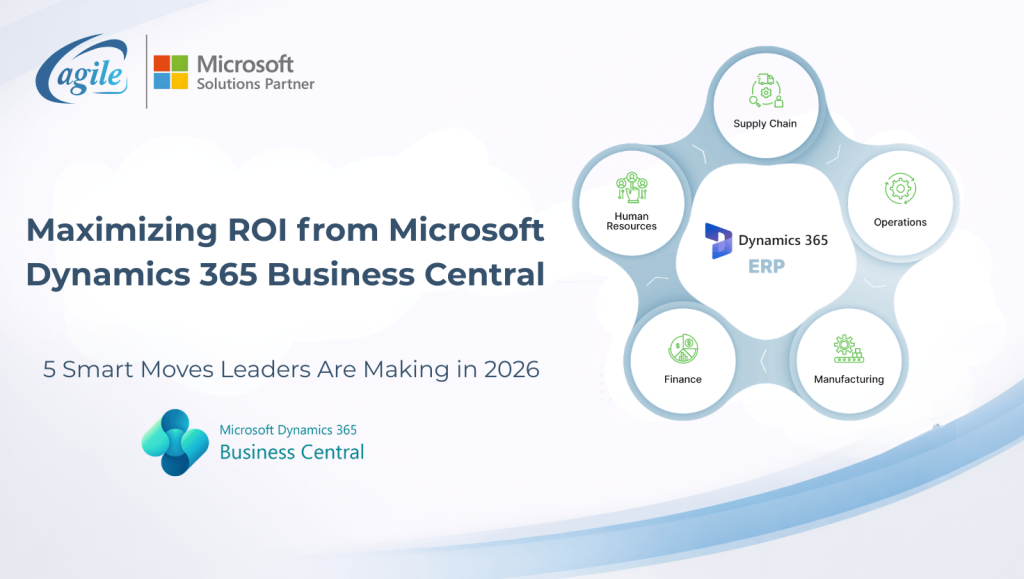
Here are 5 smart moves leaders are making in 2026 to maximize ROI from Business Central.
1. From Recording Data → Driving Decisions
Traditional approach: Use ERP for invoices, reports, and tracking.
Modern approach: Use ERP for predictive, daily decision-making.
Forward-thinking teams are:
– Reviewing real-time dashboards daily.
– Using AI-driven forecasting instead of Excel.
– Setting alerts for anomalies.
– Monitoring profitability in real time.
When ERP becomes part of daily thinking, mistakes reduce and margins improve.
2. From Finance Tool → Organization-Wide Platform
ERP should not live inside the finance department.
High-ROI organizations are:
– Giving role-based dashboards to every department.
– Aligning sales, operations, and finance on the same data.
– Making ERP part of leadership conversations.
The result? No more conflicting data. No more delays in decision-making. Just alignment.
3. From Standalone System → Connected Ecosystem
Business Central is powerful alone. But transformational when connected.
Smart leaders are integrating:
– CRM for sales visibility.
– Power BI for advanced analytics.
– Power Automate for workflows.
This eliminates:
– Manual reporting.
– Duplicate data entry.
– Operational blind spots.
Integration doesn’t just save time – it compounds ROI across the business.
4. From Static Reports → Live Business Conversations
Monthly reports show what happened. Live dashboards show what’s happening right now.
Leading organizations are:
– Tracking 5–7 critical KPIs in real time.
– Conducting weekly data-driven reviews.
– Encouraging managers to own their numbers.
When data becomes visible, accountability increases and performance follows.
5. From One-Time Project → Continuous Optimization
ERP is not a “set-and-forget” investment.
Organizations maximizing ROI are:
– Reviewing processes quarterly.
– Exploring new features regularly.
– Continuously optimizing workflows.
– Aligning ERP improvements with business goals.
ERP is not IT infrastructure. It’s a growth engine.
What High-Performing Companies Are Experiencing
Across industries, we’re seeing a clear pattern.
Companies that treat ERP strategically achieve:
– Faster financial closings.
– Better forecasting accuracy.
– Reduced operational inefficiencies.
– Improved decision confidence.
– Stronger cross-department alignment.
Not because of the software alone – but because of how they use it.
The Often Ignored ROI: The Human Impact
When ERP works the way, it should:
– Finance teams stress less.
– Operations teams plan better.
– Leadership gains confidence.
– Customers receive better service.
ROI is not just financial. It’s operational clarity and peace of mind.
A Quick Self-Assessment
Ask yourself:
– Are we leveraging real-time insights daily?
– Are all departments aligned with ERP data?
– Are we continuously improving workflows?
– Are we using integrations effectively?
– Are we actively measuring ERP ROI?
If not fully – you’re not alone. But the opportunity is still in front of you.
How Agile Solutions Helps You Unlock Full ERP ROI
At Agile Solutions, we go beyond implementation.
We help businesses:
– Align ERP with strategic goals.
– Optimize processes continuously.
– Build real-time visibility across departments.
– Integrate systems for efficiency and scale.
Because ERP success isn’t technical. It’s strategic.
Let’s Turn Your ERP Into a Growth Engine
If you’re using Business Central but not seeing its full value, it’s not too late to change that.
Connect with Agile Solutions to explore how you can maximize ROI from your ERP investment in 2026.
Let’s start with a conversation: [email protected]
Phone: +977-1-4004789 / +977 – 9802369455
Frequently Asked Questions (FAQ)
Measure Business Central ROI across four dimensions: financial (faster month-end close, reduced manual effort), operational (fewer errors, faster approvals), strategic (better forecasting, real-time visibility), and human (reduced staff stress, improved decision confidence). Track KPIs before and after implementation including days to close, reporting time saved, and inventory accuracy and review them quarterly.
Most organizations begin seeing measurable ROI within 6–12 months of go-live, provided adoption is strong and the system is properly configured. Early wins typically come from automated reporting and reduced manual data entry. Deeper ROI through integrations with Power BI, CRM, and Power Automate compounds over 12–24 months as workflows mature.
The three most common reasons are:
(1) low user adoption – staff continue using spreadsheets alongside ERP;
(2) underutilization – only finance uses the system while operations and sales remain disconnected;
(3) no continuous optimization – the ERP is treated as a one-time project rather than an evolving platform. Strategy and intent matter more than the software itself.
Connecting Business Central to Power BI transforms static monthly reports into live dashboards that leadership can review daily. Instead of waiting for finance to compile data, every department sees real-time KPIs profitability, inventory levels, sales pipeline enabling faster decisions and reducing costly delays. This integration alone can significantly reduce time spent on manual reporting.