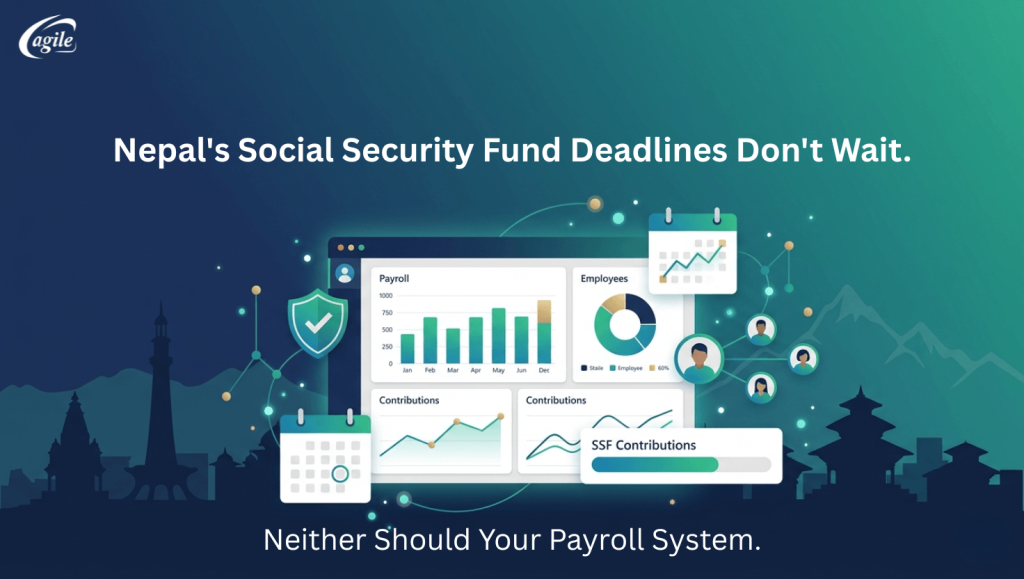

Every Nepali employer with a formal payroll carries three concurrent obligations every month: income tax withholding under Section 87 of the Income Tax Act, the 1% Social Security Tax deposit into the designated IRD revenue account, and SSF contributions under the Contribution-Based Social Security Act. Managing these across 100, 500, or 1,500+ employees using spreadsheets is not just inefficient, it is a compliance exposure that grows with every hire.
How Business Central adds value
Business Central’s HR and Payroll module localized for Nepal by Agile Solutions calculates each employee’s income tax deduction against the current progressive slab structure (1% social security tax on the first band, 10%, 20%, 30%, 36%, and 39% on higher bands) at the point of payroll processing. The 1% Social Security Tax is automatically ring-fenced into a separate payable account, preventing commingling with general tax liabilities. SSF employer and employee contributions are computed per employee, tracked to their SSF registration number, and prepared in the IRD/SSF submission format ready for upload, not re-entry. For multi-branch businesses, payroll can be consolidated across locations into a single monthly tax deposit schedule.
Tax slab automation: All 6 income tax brackets applied per employee each month.
SST ring-fencing: 1% Social Security Tax tracked to separate IRD revenue account.
SSF contribution: Employer/employee portions computed and formatted for SSF portal.
Multi-branch payroll: Consolidated tax deposits across all locations from one dashboard.
Nepal policy alignment
Income Tax Act 2058 – Section 87 / SSF Act 2074
Section 87 requires every employer to withhold and deposit salary tax monthly and issue annual withholding statements. The Finance Act 2081/82 updated slab rates effective Shrawan 1, 2081 any employer still running pre-2081 slab calculations is overpaying or underpaying tax.
The SSF’s Contribution-Based Social Security Act 2074 mandates employer contributions on a per-employee basis. Non-compliance attracts penalties and restricts access to government procurement a material risk for businesses.
Conclusion
At 1,000+ employees, a single month’s payroll error compounds across twelve months of deposits, annual withholding statements, and employee SSF accounts. Business Central eliminates the manual calculation layer entirely giving HR teams a payroll that is compliant by design, not by chance.
Frequently Asked Questions (FAQ)
Every employer in Nepal must comply with three key monthly obligations:
– Income tax withholding under Section 87 of the Income Tax Act.
– 1% Social Security Tax (SST) deposit to IRD.
– SSF contributions under the Contribution-Based Social Security Act.
Failure to meet these obligations can result in penalties and compliance risks.
Business Central automates payroll calculations, ensuring:
– Accurate income tax deduction based on updated tax slabs.
– Automatic segregation of 1% Social Security Tax.
– SSF contributions calculated per employee and formatted for submission.
– Elimination of manual spreadsheet errors.
This ensures compliance is built into the payroll process.
For companies with 500+ or 1,000+ employees:
– Manual calculations increase error rates.
– Tax slabs may not be updated correctly.
– SSF tracking becomes inconsistent.
– Data duplication leads to reporting issues.
These risks compound monthly and can lead to compliance violations.
The system:
– Calculates employer and employee contributions automatically.
– Links contributions to employee SSF numbers.
– Prepares data in SSF submission format.
– Eliminates re-entry into the SSF portal.
This simplifies compliance and ensures accuracy.
Yes. Business Central supports:
– Consolidated payroll processing across branches.
– Centralized tax reporting.
– Unified deposit schedules for IRD and SSF.
This is especially valuable for banks, automotive groups, and large enterprises.