
Manufacturing has always been one of the most challenging and demanding industries. There is a growing realization that the manufacturing industry post-COVID-19 will not be the same. For an industry crucial to the Nepalese economy, widespread disruption to supply chains and weakening market demand have presented critical challenges. In this scenario, business intelligence has been proved to be an essential tool for businesses.
Companies continue to strive to get simplified and effective software to reduce costs, maintain product quality and increase profits. Relying on spreadsheets for making business and operational decisions can lead to falling “behind the truth” with outdated information.
COVID-19 has highlighted that now more than ever, the need for a robust Business Intelligence ecosystem for companies is a no-brainer. It has introduced significant difficulties in the supply chain and as a result, the following needs have emerged:
- Manage and use company data: tap on great information and bring a simple understanding of improving business performance and maintaining regulatory compliance.
- Manage large amounts of data from multiple sources, including providers, distributors, customers, data.
- Improve efficiency and reduce costs by analyzing profits and losses, including product sales analysis, consumables, supplier exposure, and cost-effectiveness of various distributors.
Why Business Intelligence?
Financial Management
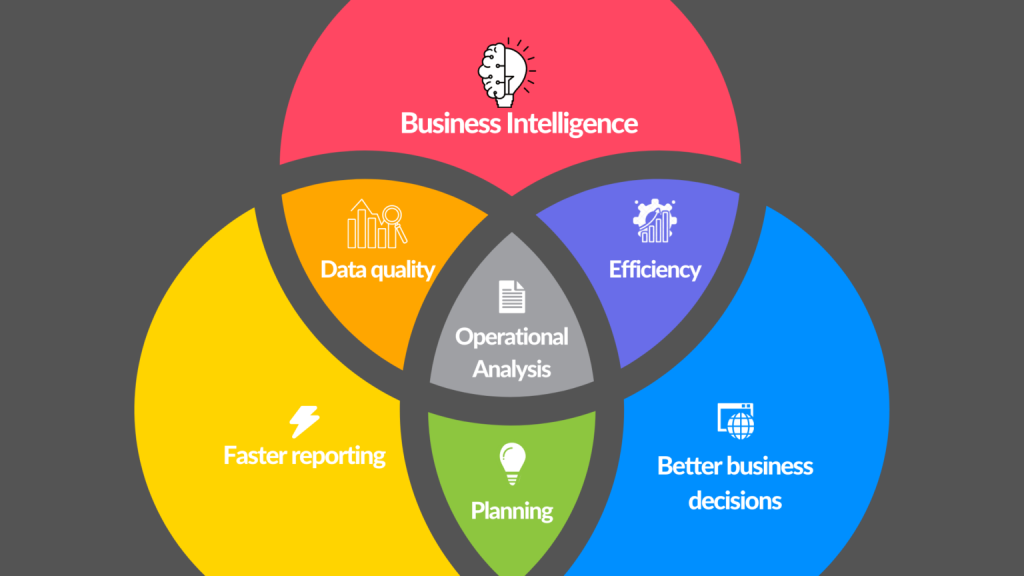
Business Intelligence in production can be used for various analyses such as Profit & Loss, Sales, Inventory, Assets, etc. Therefore, you can get an idea about the ROI directly from each category.
It allows for in-depth cost analysis that helps companies manage production costs through multiple layers of information.
It also helps to simplify operational processes by controlling and monitoring processes. Along with this, businesses can have proper demand-supply analysis, the BI can manage the value chain very efficiently.
Making an informed Decision
With the massive influx of data from multiple sources, the need for proper management, storage, and use of all this data arises. This is where BI helps you.
With Business Intelligence, you can access a large, complex database and convert it into pieces that are understandable and easy to understand.
With the help of BI tools, the analysis can be easily visualized as well as it is an important business metric and KPIs for business managers.
This helps decision-makers to make informed and concise decisions. Information from all sources can be carefully included in decision-making. It can also evaluate the ‘what if’ conditions to do the project and analyze other strategies.
Improved Analytics
BI can assist in managing shipments by evaluating their daily performance and analyzing data to ensure timely delivery and quality service. It can monitor the cost of goods by identifying changes in sales and demand. If certain features do not work as they should, analytics will help you to identify them before they become a problem. So, analytics help you work better.
The manufacturing industry is facing heaps of changes. Globalization, new technologies, and competitiveness are some of the reasons behind the changes. Organizations are looking for solutions to expand their complex process, reduce costs and gain more control over their system. Information is the key to any problem as we always use the information we receive. The most important value of Business Intelligence is that its ability to enable managers to know exactly what they need to do to grow their business.