
How BC handles multi-branch finance, compliance reporting, and real-time reconciliation – and whether your business is ready.
Nepal’s business landscape is shifting fast. Whether you run a BFI with branches across provinces, a trading house managing multiple warehouses, or a services firm navigating IRD compliance – the pressure to move beyond spreadsheets and disconnected systems has never been greater.
Microsoft Dynamics 365 Business Central (BC) is emerging as the platform of choice for mid-to-large Nepali enterprises seeking unified, cloud-ready ERP. But is it right for your business – and are you ready for it?
This guide gives you the straight answer.
Multi-Branch Finance: One Chart of Accounts, Unlimited Locations
If you operate across branches – be it Birgunj, Biratnagar, Pokhara, or Nepalgunj – consolidating financials manually is a nightmare. Delayed reports, inter-branch reconciliation errors, and inconsistent data across locations are signs your current system is holding you back.
What Business Central does differently:
– Dimensions-based branch tracking, post transactions at branch level without separate company databases.
– Inter-company postings – automate inter-branch lending, cost allocation, and fund transfers.
– Consolidated financial statements, generate group P&L and balance sheets across all locations in minutes.
– Branch-wise budgeting and variance analysis, track performance by location, department, or cost center.
Compliance Reporting: Built for NRB, IRD, and Labor Act Requirements
Regulatory compliance is non-negotiable in Nepal. Whether it is NRB’s prudential reporting requirements for BFIs, IRD’s TDS/VAT return formats, or SSF and EPF contribution statements – your ERP must generate these accurately, every time.
Business Central’s compliance capabilities:
– Custom report layouts, design VAT, TDS (CIT), and withholding tax reports in IRD-prescribed formats.
– Payroll compliance – compute EPF, SSF, and CIT deductions automatically, with Form 29 and SSF contribution export.
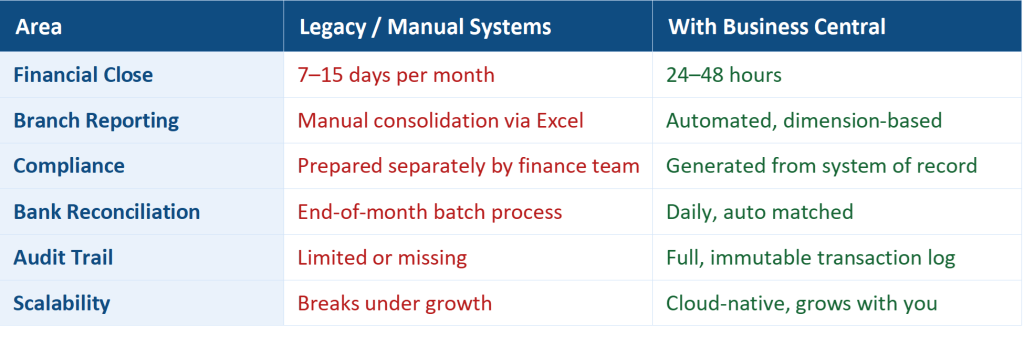
– Audit trail, every financial transaction carries full traceability; no record can be deleted, only reversed.
– Fiscal year flexibility – supports Bikram Sambat (BS) calendar alongside Gregorian for NRB submissions.
– Role-based access control – restrict compliance data to authorized finance and audit personnel only.
Real-Time Reconciliation: Close the Books Without the Last-Minute Rush
Reconciliation delays are one of the most common pain points for CFOs. When your general ledger, bank statements, accounts receivable, and payables live in separate systems or worse, in Excel the month-end close becomes a high-stress sprint.
How BC eliminates reconciliation bottlenecks:
– Bank reconciliation module – import bank statements and auto-match transactions with posted entries.
– Real-time GL posting – every sales invoice, purchase order, and payment posts to the GL instantly.
– Outstanding AP/AR aging reports – live dashboards, no end-of-month batch runs.
– Payment journal automation process vendor payments in bulk with bank file export (NEFT/RTGS compatible).
– Cash flow forecasting, project weekly and monthly liquidity based on open orders and payables.
Is Your Business ERP-Ready? A Quick Assessment
Implementing BC is an investment in technology, time, and change management. Before you proceed, honestly assess where your business stands today.
The 5 Signs You Are Ready to Implement Business Central
- Your finance team spends more time collecting data than analyzing it.
- Month-end close takes longer than 5 working days.
- You cannot produce a branch-wise P&L without manual effort.
- Compliance filings (TDS, VAT, EPF, SSF) are prepared outside your core system.
- Leadership cannot access real-time financial data without waiting for a report.
Ready to Take the Next Step?
Agile Solutions is Nepal’s trusted Microsoft Solutions partner, with proven deployments across banking, financial services, government and enterprise sectors.
We do not just install software – we configure, localize, and support BC to meet Nepal’s specific regulatory, operational, and cultural requirements.
Frequently Asked Questions (FAQs)
Dynamics 365 Business Central (BC) is Microsoft’s all-in-one ERP for finance, purchasing, sales, inventory, and reporting designed for growing small and mid-sized organizations that want one system of record.
Costs typically have two parts:
(a) Microsoft subscription licensing per user, and
(b) implementation services (requirements, configuration, data migration, training, and local compliance). Your final cost depends on user count, modules, customizations, and how complex your compliance/reporting needs are.
Business Central is commonly licensed by role. Essentials covers core financials and operations; Premium adds advanced capabilities such as manufacturing and service management (where applicable); Team Members provide light access for users who mainly need read/approve and limited entry. A partner can help map roles to the right licenses, so you don’t overbuy.
Most organizations prefer cloud for faster rollout, lower infrastructure overhead, and continuous Microsoft updates. On-premises can make sense if you have strict hosting requirements or legacy dependencies. In either case, focus on security, connectivity, and a clear upgrade strategy.
Yes, BC can be configured and extended to support Nepal-specific reporting needs (for example VAT/TDS formats, audit trails, role-based access, and regulatory reporting). Typically, your implementation partner localizes report layouts, tax logic, and exports to match current requirements.