How Microsoft Dynamics 365 Business Central helps Nepali banks automate payroll, streamline leave, and stay audit-ready.
Nepal’s banking sector is fiercely competitive – yet many institutions are still managing their most valuable asset, their people, with spreadsheets, paper forms, and disconnected payroll tools. In 2026, that is no longer a minor inconvenience. It is an operational and regulatory liability.
The Real Cost of Legacy HR
Manual HR processes create compounding problems that directly impact the bottom line:
– Payroll errors that expose banks to regulatory penalties and damage staff trust.
– Non-compliance with Nepal’s Labour Act, Income Tax Act, SSF, and CIT requirements.
– Talent attrition – younger banking professionals expect digital, transparent HR tools.
– No real-time workforce data, making strategic planning impossible.
What Traditional HR Systems Get Wrong
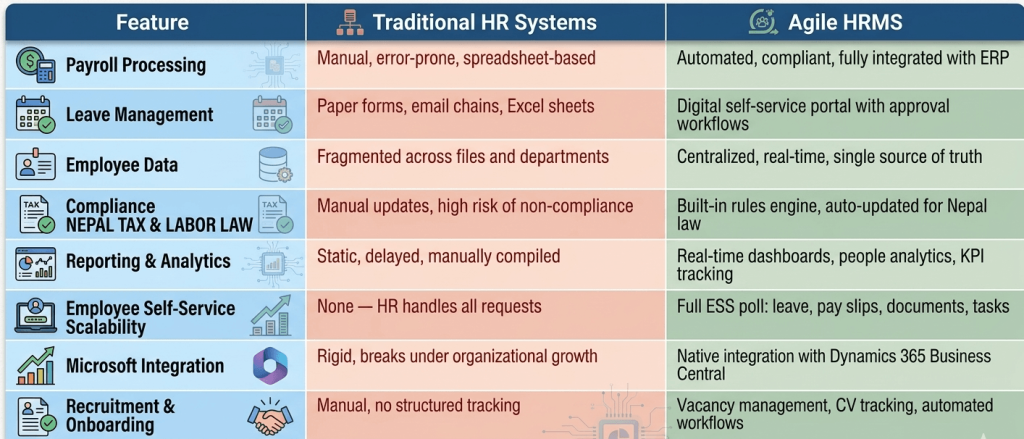
Traditional HR management in Nepal’s banking sector typically relies on a patchwork of disconnected tools: a payroll software from one vendor, an attendance register from another, leave tracked on Excel, and performance appraisals on paper. This fragmentation creates systemic problems:
– No single source of truth – employee records are duplicated and inconsistent across systems.
– Manual data entry creates error propagation – a mistake entered once cascades through payroll, tax, and reporting.
– Zero employee self-service – every leave request, pay slip retrieval, or document access requires HR intervention.
– Reporting is reactive and delayed – managers get last month’s data when they need today’s insights.
– Scalability is impossible – adding 50 new employees or a new branch means proportionally more manual work.
– Integrations don’t exist – HR, finance, and operations operate in silos with no data flow between them.
Traditional Systems vs. Agile HRMS
Why Agile HRMS is Built for Nepal’s Banking Sector
Agile Solutions is not a generic HR software reseller. As a Microsoft Partner with deep implementation experience in Nepal’s financial services ecosystem, Agile’s HRMS has been purpose-built and localized for the unique demands of Nepali organizations – including banks, development banks, and finance companies.
1. Built on Microsoft Dynamics 365 Business Central
Unlike standalone HR tools that operate in isolation, Agile HRMS is natively built on Microsoft Dynamics 365 Business Central – one of the world’s most trusted business management platforms. This means your HR data doesn’t just live in an HR bubble. It connects directly to your finance and accounting modules, eliminating manual journal entries for payroll postings and providing a unified view of your organization’s financial and human capital.
2. Full Nepal Compliance Built In
Agile HRMS is designed to handle Nepal’s specific regulatory environment out of the box – covering Income Tax Act compliance with automated tax calculations, Provident Fund (PF) and Citizens Investment Trust (CIT) processing, Labor Act-compliant leave entitlements, overtime rules and gratuity provisions, Social Security Fund (SSF) contribution management, and salary slip generation in formats accepted by Nepal’s regulatory bodies. And when the law changes, Agile updates the system – so your institution stays compliant without any manual recalibration.
3. End-to-End HR Coverage, Not Just Payroll
Most traditional HR systems in Nepal focus narrowly on payroll – but Agile HRMS covers the entire employee lifecycle, from the moment a candidate applies to their final settlement. The full feature set spans recruitment and onboarding, centralized employee profile management, digital leave and absence tracking, automated payroll processing, performance appraisals, training and development, an employee self-service portal, travel and expense management, and structured exit and separation workflows – everything a modern Nepali bank needs in one platform.
4. Employee Self-Service That Empowers Your Workforce
One of the most transformative features of Agile HRMS is the Employee Self-Service (ESS) portal because today’s banking professionals expect the same digital convenience from their employer that they deliver to their customers. Through the ESS portal, employees can apply for leave and track approvals in real time, access and download pay slips, update personal information and documents, manage tasks and performance goals, and view their full employment history – all from any device, 24/7. For HR teams, this means the relentless volume of routine administrative requests that currently consumes hours every week simply disappears, freeing HR to focus on strategy, culture, and people development.
5. Personalized HR Dashboards and People Analytics
Agile HRMS transforms HR from a reactive administrative function into a proactive strategic partner through powerful, real-time dashboards and analytics – giving branch managers, department heads, and HR leaders a personalized view of exactly the data they need. From attendance and absenteeism trends, headcount and attrition, leave utilization forecasts, and competency gap analysis, to performance distribution and promotion readiness, every key metric is visible at a glance. In a banking environment where staffing decisions directly affect customer service levels and regulatory compliance; this kind of intelligence is not a luxury – it is a competitive necessity.
6. Trusted by Nepal’s Leading Organizations
Agile’s HRMS is not a theoretical product. It has been implemented and is actively trusted by some of Nepal’s most recognized institutions, including NIMB Bank, NMB Bank, Everest Bank, Prabhu Bank, NIC Asia Bank, Nepal CRS Company, Family Planning Association of Nepal (FPAN), Toyota Nepal, and others. This track record means Agile understands the specific operational and cultural nuances of Nepali organizations – and builds solutions that work in the real Nepal, not just on a product demo.
Making the Switch: What to Expect from Agile
Transitioning from a legacy HR system to a modern HRMS is a significant decision, and understandably, institutions want to know what the process looks like. Agile Solutions has structured its implementation approach to minimize disruption and maximize time-to-value:
Rapid Implementation – Agile HRMS is designed for quick deployment, with a structured onboarding process that gets your team operational without lengthy, disruptive project timelines.
Data Migration Support – Agile’s implementation team manages the migration of your existing employee records, payroll history, and configuration data into the new system.
Localization and Configuration – the system is configured to your specific pay structures, leave policies, approval hierarchies, and compliance requirements before go-live.
Training and Change Management – comprehensive training for HR administrators, managers, and employees ensures adoption is smooth and confident.
Ongoing Support – Agile provides continuous support, system updates, and compliance maintenance so your investment remains current.
Conclusion: The Upgrade Your People Deserve
Nepal’s banking sector has always understood the connection between institutional excellence and the quality of its people. The tools and systems used to manage, develop, and reward those people should reflect that understanding.
Traditional HR systems served a purpose in a different era. In 2026, they are a liability – operationally, financially, and reputationally. The banks that recognize this and act decisively will not only reduce their risk and cost of HR operations. They will build the kind of modern, transparent, empowering workplace that attracts and retains Nepal’s best banking talent.
Agile’s HR and Payroll Management Solution is not just a software upgrade. It is the foundation for a smarter, more resilient, and more human way of managing your institution’s most valuable asset.
Frequently Asked Questions
Legacy HR platforms were designed for simpler, single-location businesses. They lack the multi-branch payroll automation, digital leave workflows, real-time GL integration, and built-in NRB compliance that modern banking demands. As regulatory expectations increase, the cost of staying on outdated systems grows every year.
Yes. HR for Banking inside Microsoft Dynamics 365 Business Central supports 100+ branches with branch-wise salary structures, location allowances, and grade-based pay scales in a single automated payroll run – something traditional HR tools cannot do reliably.
Yes. HR for Banking is a native module inside Microsoft Dynamics 365 Business Central, meaning payroll posts directly to the general ledger with zero manual journal entries and no reconciliation required.